
|
|
Medical Imaging Networks
Cmput 313
April 9th/1998
Brent Knowles
Grant Carstensen
Trent Hoeppner
Abstract
Medical imaging networks have paved the way for many medical applications, but there are many difficulties, both technical and sociological that need to be overcome. While significant progress is being made, it is still not fully embraced by many in the health care industry.
Executive Summary
Our goal in presenting medical imaging networks was to provide a summary of the past and current issues in this area.
Findings
Benefits
Problems
Possible Solutions
Future Trends
Introduction
PACS plays a vital role in medical imaging networks. Improved international standards are paving the way for the interconnection of intra-hospital PAC systems. Telemedicine is just one example of a medical application that will emerge from widely implemented PACS. There are many advantages to a PACS over the film based systems including cost decreases, multiple access to single patient records, and data gathering on health-care trends.
There are still many obstacles facing PACS including the slow development of international standards, like DICOM, unproven cost effectiveness, and legal issues, as well as bandwidth requirements for network infrastructure. There are signs that the medical industry is advancing to a more digital hospital.
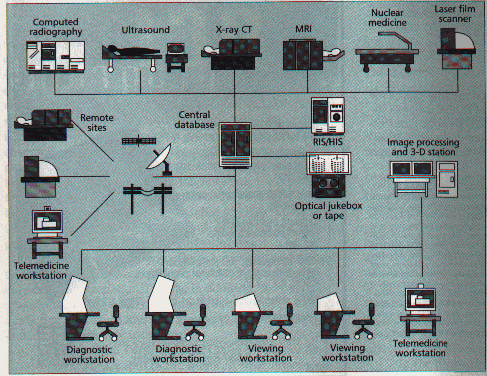 PACS and Telemedicine
Figure 1: Telemedicine example using PACS over remote sites
.A main component to a medical imaging network is a PACS (Picture Archiving and Communications System). A PACS involves all aspects of diagnostic imaging within a hospital setting including image acquisition, storage, transmission, retrieval, and display. Figure 1 shows an example of a PACS with remote terminals.1 As imaging devices which produce digital output become more readily available, PACS systems will become more common.
A PACS is the first step towards large-scale medical imaging networks. A PACS is all internal to a hospital, but the possibility of interconnecting PACS system between hospitals is becoming more practical as better standards and technologies emerge. These medical networks are already in existence, but most are still in the prototyping stages.
Medical imaging networks will allow for much more than the transfer of diagnostic images. Telemedicine is one possible application. Telemedicine is the use of telecommunications to aid health care. This can be anything from telediagnosis, teleconsultation, to education and conferencing tools relating to the health care industry.
Telediagnosis is where the primary diagnosis is made from a remote location. This relates to the remote terminals in Figure 1. Teleconsultation is where the primary diagnosis is made in the same location as where the patient is, however a remote doctor can be contacted for a second opinion. The idea is that expert advice can be utilized regardless of location. Telemedicine has large bandwidth requirements, as medical images are quite large. Table 1 shows some typical sizes for common medical images.2 Also telemedicine requires real-time transmission for many of its applications such as video conferencing.
Another possibility related to telemedicine is the virtual record. If hospitals were all interconnected then patient records could be scattered throughout the world. A patient's file could be presented as a group of objects from each hospital. Figure 2 shows one possible representation.3 A virtual patient record might allow the patient himself access to his record. He could then follow up on his treatment reporting any problems to the physician.
PACS and medical imaging networks have several advantages over traditional film based technologies. One is multiple access. With a hard copy of a patients file, only one doctor may peruse it at a time. However with a PACS implemented, multiple doctors could access the patient's records at once. This would most directly benefit the patient resulting in better care. Also faster image retrieval seems probable. With film, accessing an existing diagnostic image requires finding the hardcopy and physically delivering it. With a network, the image (with no network problems) should be available in a matter of seconds. This would benefit both patients and doctors. Doctors would save time and 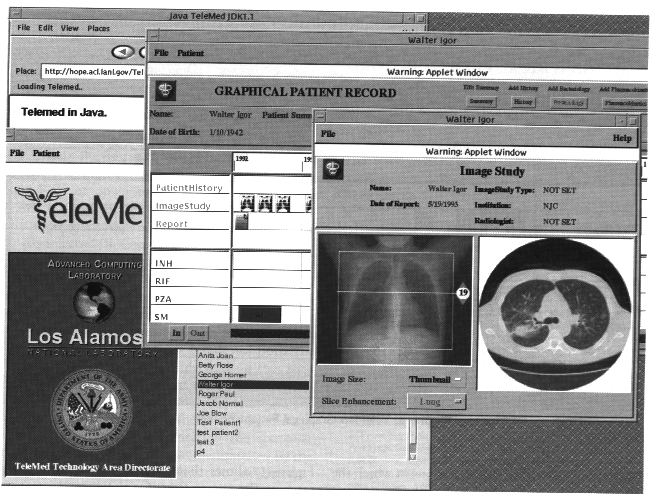
Figure 2: Virtual Patient Record
patients would get faster care.
With digital imaging, images can be manipulated after being captured. For example contrast or brightness can be adjusted, zooming option are available, as well as diagnostic algorithms could be used to help diagnosis.
Lastly, diseases and health issues could be tracked and analyzed by demographics with ease. This could help identify trends in health care and benefit everyone through better identifying health concerns, and educating the public.1
There are several obstacles to the widespread implementation of PACS and medical imaging networks. One obstacle is the large image files associated with medical images. This put heavy demands on networks resulting in expensive infrastructure considerations. The slow development of international standards has made it difficult for different vendors to produce compatible equipment. DICOM 3.0 is the latest and most widely accepted standard and has made some ground in bringing vendors together. One largely unexplored issue is the legality of telemedicine in general. Who is liable in a remote diagnosis? Questions like these need to be answered.
Lastly, resistance from doctors has slowed and will continue to slow the conversion to an all digital hospital. Doctor's still feel reluctant to make primary diagnosis from monitor screens.6 They feel unsure about the resolution and have less confidence in making their diagnosis. Although statistically, this fear is ungrounded, it will take time before it is overcome.
Standards and Implementation Issues
The DICOM standard has become a major force behind medical imaging networks. Devices created for medical purposes, such as MRI scanners, are made and supplied by many different vendors. Yet, if they are connected over a network, they must be able to communicate with one another. DICOM is the mechanism that makes this communication easier.
ACR/NEMA completed a number of standards before creating DICOM. The
most influential predecessors to DICOM were ACR/NEMA 1.0 and ACR/NEMA 2.0, released in 1985 and 1988, respectively. These standards use an OSI model of implementation, including all the layers of a network protocol stack.4 This design allows the protocol to be implemented easily over a network since the independent layers allow simpler modification and reduced design complexity.
The features of DICOM 3.0, released in 1992 and 1993, that distinguishes it from these older standards is that it takes an object-oriented approach. Devices use Information Objects and Service Classes to handle data. Information Objects contain the data, meta-data, and other relevant information required for processing, while Service Classes identify which Information Objects can be processed and in what way. As a simplified example, one device might broadcast a message over the network, "I have an X-Ray image to be stored." Another device on the network might broadcast, "I can store
X-Ray images," in response and a connection would be set up to transfer the image and store it.4
An important feature of DICOM is that it allows data to be encapsulated within an object without examining the data itself. This is particularly important to reduce processing time before the transfer of compressed images, and as a design issue it is independent of changes in image formats and compression schemes. In contrast, the
TIFF general image standard tried to decipher JPEG elements as a part of the standard. The attempt failed due to the complexity of the JPEG standard. This also made TIFF more vulnerable to changes in the JPEG standard.
There are several issues to consider about the network. The first is the bandwidth that will be required for the network. There are different network demands for different types of data, ranging from 10 kb/s to 15 Mb/s for one application (Table 2).1 The total bandwidth depends on the needs of the system to be implemented, but a few workstations
requiring high bandwidth or many workstations requiring low bandwidth will make the overall bandwidth high.
Another network consideration is the traffic of the data. With patient records and still images like digitized X-Rays, traffic will be bursty, but may have a great deal to transfer. 1 To illustrate this point, consider that a doctor would request such data about a patient infrequently, but may need all information on the patient to get a better idea of the proper diagnosis.
On the other hand, video conferencing for the purpose of teleconsultation would involve constant traffic over the network for time periods of minutes to hours during an operation. This situation also requires very short response times from the network.
The network must also be extremely reliable. Still images are often large, but one error can result in a misdiagnosis, which has great legal and ethical implications. It is also important that streaming video not be interrupted in the middle of an operation, since the teleconsulting physician may be about to give information at a critical point in some procedure.
To meet these demands, we must choose the appropriate network system.5 The two most plausible choices are ISDN and ATM. Both are implemented as a switched service, and are connection-oriented. The latter aspect is important for video applications. Although ISDN is cheaper, it has a maximum bandwidth of only 1.92 Mb/s. On this point, ATM is the superior choice since the theoretical range is 1.54 Mb/s to 2.2 Gb/s. Also, ATM guarantees a maximum delay between cells, which is also essential for video streaming.
When discussing a medical imaging network, we must also consider storage of medical data. In this regard, image compression techniques are a major issue. Traditionally, medical images have used lossless compression schemes, with compression ratios between 2:1 and 4:1.1 On the other hand, lossy compression algorithms like JPEG offer a dramatic improvement, with compression ratios between 10:1 and 20:1, which are visually lossless.
Another storage consideration is the physical capacity of the system. Hospitals currently generate 1 to 2 terabytes of data per year, with projections to 100 terabytes per year.7 Since medical records must be stored for up to 10 years, the system must be able to absorb a great deal of data. Moreover, patient records must be retrieved quickly and automatically in an emergency, adding to the cost of the system.
One solution is the CD-R Jukebox. In this system, many rewritable CDs are stored in one central location. When a patient record is needed, the appropriate CD is selected and read. So we get fast access to large volumes of data.
Another solution is a RAID system. RAID (Redundant Array of Inexpensive Disks) achieves cheap, reliable storage with fast access times. This is accomplished with a large number of commercial disk drives which operate in parallel. Data is duplicated across multiple drives, so that if one fails, the data is still available. Also, a failed drive can be replaced at low cost.
There are also many legal issues involved in medical imaging networks. The first is the liability of physicians operating at remote locations. A doctor being asked for a second opinion through teleconferencing may be located in a different province/state or even a different country. If any problems occur with a patient, it may be difficult to determine who is liable.
A related issue is licensing of doctors to work across a network. In the US, physicians are licensed on a per-state basis, complicating the issue of working in unlicensed states. This problem is magnified between countries where different standards for medical excellence exist.
Another legal problem is the verification of identity. Privacy of patient data must be maintained to protect the patient's rights.8 However, when operating over a WAN or the Internet, security becomes a major problem. In addition, the destination must be able to verify the integrity of the source, and the same applies to the source with respect to the destination.
Image compression is also a legal issue. Most physicians are afraid that lossy compression schemes will reduce the quality of their diagnoses.9 If a misdiagnosis occurs based on an image compressed in this manner, the lossy scheme may be considered the problem and the doctor may be liable. This attitude persists even though studies show that compression schemes which are visually lossless have no effect on the quality of the diagnosis.
Real World Implementations
The Cross Cancer Institute is an example of a medical clinic that still relies heavily on proven technology. With the use of their daylight processing film, with a small turnaround time of ninety seconds, they see little advantage in going digital for the majority of their radiology needs. There is the possibility that they may obtain a digital chest X-Ray unit. Currently, they employ a digital system for their CT's, MRI's and ultrasounds, yet still rely on hardcopy printouts for archival purposes. A LAN is used mainly for internal reporting, but there are no external network connections for the purpose of medical imaging. Modern technological medical equipment has yet to prove its cost effectiveness to the Cross Cancer Institute.9
Calgary's General Hospital, although similar to the Cross Cancer Institute in terms of technological level, represents a hospital on the verge of adopting the new technology that is available. Most of their internal imaging needs are handled digitally, but they also store a hardcopy of their images. They do not rely on, nor do they have the capacity to store images digitally for the long-term. They have no formal outside network connections, because there is no dedicated network available for the hospital that can manage the high bandwidth needed. However, they employ a dial-up service for their radiologists, so that the doctors can obtain digital images from the hospital. Using an 8 to 1 compression scheme, the images are transported relatively quickly to the radiologist's house, where they are confident in making diagnosis of easy to read problems. Cost effectiveness is the main reason that Calgary's General Hospital does not commit to a fully digital solution. The hardware cost, combined with the uncertainty that many doctors face in dealing with digital images, keeps the hospital from committing completely to medical imaging networks.10
The Foothills Clinic, a woman's center in Calgary, has implemented a fully digital ultrasound system. This PACS system acquires, manipulates, and stores ultrasounds, all in a digital format. CD-R drives are used to store the ultrasounds. However, like the other two medical institutions that have been mentioned, they have no formal external network communications with other hospitals. If ultrasounds need to be sent somewhere else, they are done so using hardcopy.10
The last medical clinic we will discuss in this report is the Baptist Bellevue Medical Center, located in Tennessee. It used to send its radiology film to the nearby Baptist Hospital for diagnosis. This used to require around twenty-four hours for a diagnosis to be made on the film. In life threatening situations, the medical center would simply transport the patient to the Baptist Hospital, to avoid the large time delay in reporting. This resulted in the Baptist Bellevue Medical Center not running to its full potential.7
To deal with this problem they installed a DICOM compliant medical imaging network. Now they are connected to the Baptist Hospital, and there are plans for a large number of smaller medical clinics to join this network. Turn around time has decreased from twenty-four hours to four. If an immediate diagnosis is needed it can be done in minutes. For the Baptist Bellevue Medical Center, the future of the medical industry has arrived.7
Summary and Predictions
The enormous literature on the subject of medical imaging networks alone is overwhelming. Our health is one of the most important factors in our life and it is not surprising to find such a large amount of interest in the future of the medical industry. Yet, we must remain aware that to simply jump into an unproven technology is not the wisest thing to do. The adoption of this new technology is slow, but for good reason. Doctors are entrusted with the responsibility for human life, and they take this responsibility seriously. As more hospitals adopt and find success with medical imaging networks, the confidence of the medical industry as a whole will increase. With this confidence will arrive a merger of technology and medicine.
The most obvious impact for the future will be the exchange of knowledge among practitioners. Doctors around the world will be able to keep up with the most important developments in the world of medicine. They will not have to worry about being two or three years behind the latest surgical procedures.
As virtual reality matures it will take its place in the medical industry. Even today a virtual colonoscope promises a less invasive, easier to use, and more accurate medical procedure.12 Rather than multiple expensive monitors to display x-rays simultaneously, virtual reality goggles could be used. Also, we might well see a future where remote controlled robots may travel through the organs of the body, looking for tumors or obstructions and removing them. A surgeon may be able to perform a surgical procedure using the steady hands of a robot physician from a thousand miles away.
The future is never bliss. A remote-network surgery would need enough redundancy to ensure that any disaster would not bring a surgery (and a life) to an abrupt end. If our medical records become available over a network, it remains to be seen whether a precedent will be set allowing corporations, governments or even individuals open access to these records. If this happens, we will be judged more on our medical history than ever before by prospective employers, insurance, and even bank loans. Personal health problems due to negligence would be more difficult to overcome since they would be public knowledge.
References
1. James E. Cabral Jr., Yongmin Kim. "Multimedia Systems for Telemedicine and
Their Communications Requirements." IEEE Communications. Vol. 34. No. 7.
July 1996. pp. 20-27.
2. H.K Huang. "Teleradiology Technologies and Some Service Models." Computerized
Medical Imaging and Graphics. Vol. 20. No. 2. March 1996. pp. 59-68.
3. David G. Kilman, David W. Forslund. "An International Collaboratory Based on
Virtual Patient Records." Communications of the ACM. Vol. 40. No. 8. August
1997. pp. 111-117.
4. DICOM FAQ. http://idt.net/~dclunie/medical-image-faq/html/"
5. B.K. Stewart, S.L. Lou, A. Wong, K.K. Chan, H.K. Huang. "Performance
Characteristics of an Ultra Fast Network for PACS." Medical Imaging V: PACS
Design and Evaluation. San Jose, California. March 1991. pp. 141-153.
6. James G. Anderson. "Clearing the Way ofr Physicians' Use of Clinical Information
Systems." Communications of the ACM. Vol. 40. No. 8. August 1997. pp. 83-90.
7. Eastman Kodak Company. www.kodak.com.
8. Thomas C. Rindfleisch. "Privacy, Information Technology, and Health Care."
Communications of the ACM. Vol. 40. No. 8. August 1997. pp. 93-100.
9. Radiologist from Cross Cancer Clinic. Telephone Interview. April 1998.
10. Mike from Calgary General Hospital. Telephone Interview. April 1998.
11. Francis Hamit. "Virtual Endoscopy & Colonoscopy: VR and Truly Less-Invasive
Imaging." Advanced Imaging. October 1997. pp 51-52.